TOFU vs BOFU: Why One Voice Cannot Carry the Whole Funnel
Writing an article is useless when it is not timed to the sales funnel. Plenty of commentators now claim the funnel is dead or endlessly reshaped, and the debate misses the operational point: content has to vary with the reader’s proximity to a buying decision. A reader three questions away from a purchase needs a different page, a different vocabulary and a different voice than a reader three months away. Teams that write everything in one register lose both readers at once.
This article sits inside the larger framework laid out in The Corporate Communication System, and it picks up the thread Message Architecture left open: themes decide what a company says, funnel stages decide how it must be said at each distance from the money. The proof here comes from a SaaS migration business where eight experienced writers were producing 40 pieces of content a week, and seven pages written differently did the converting. The closing section explains why impressions, the metric most reports celebrate, routinely mislead funnel decisions.
What Is TOFU BOFU Content?
TOFU BOFU content is content matched to the reader’s distance from a buying decision. TOFU (top of funnel) content attracts the right decision-maker through the pain points that start a purchase. BOFU (bottom of funnel) content closes that decision with price, proof and reassurance.
The acronyms come from the classic marketing funnel: top, middle and bottom. The labels matter less than the underlying discipline. Every piece of funnel content answers one governing question: how close is this reader to spending money, and what does that closeness change about what the page must say. Distance changes the reader’s questions, patience and vocabulary. Content that ignores the distance speaks fluently to nobody.
The funnel-is-dead argument does not survive contact with this definition. Buying paths loop, stall and restart, and the modern buyer researches alone for most of the journey. None of that abolishes proximity. A CFO comparing two vendors on a Thursday evening is close to the money. A founder reading about migration risks for the first time is far from it. TOFU BOFU content is simply the practice of writing for that difference on purpose.
Who Decides the Purchase: the Customer or the Consumer?
The customer decides the purchase, and the customer is frequently not the person who will use the product. The consumer operates the software, attends the training and lives with the tool daily. The customer signs the payment and answers for the outcome. Funnel content that speaks to the consumer’s daily problems while the customer holds the budget is aimed at the wrong chair.
The distinction sounds academic until it decides a content plan. In B2B, the user and the buyer usually sit in different roles with different anxieties. The user cares about workflows and features. The buyer cares about downtime, cost, compliance and risk to their own standing. A documented customer persona exists precisely to force this choice: name the person whose signature releases the money, and write the funnel for that person first.
Most content teams default to the consumer, for an honest reason. The consumer’s problems are technical, searchable and comfortable to research from a desk. The customer’s problems are commercial, and finding them requires talking to salespeople and reading the business the way an owner reads it. The comfortable path produces expert content for the wrong reader. I watched a talented team walk that exact path.
What Happened When 40 Articles a Week Met Seven Pages?
Seven pages aimed at the buying decision outperformed an entire library aimed at the technical user. That is the short version of what happened when I inherited the content team at a SaaS accounting platform whose flagship offer included data conversion services for businesses migrating between accounting systems.
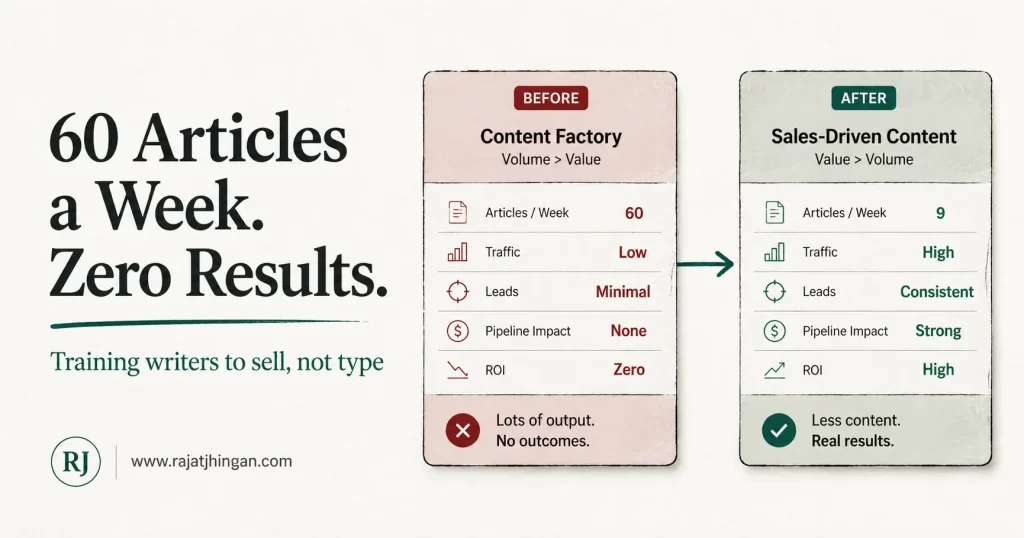
The team I took over was strong: roughly eight writers, experienced in accounting and finance, producing close to 40 pieces of content every week. Their instinct was depth. They wrote long technical pages on migration error codes, data conversion faults and their resolutions, the kind of material an accountant troubleshooting a stuck migration would genuinely value. I let them continue exactly as they were. I took a different lane and committed to writing six to seven pages myself, on the bet that those pages would carry the conversion load.
The Consumer’s Page
“Error 6177: resolving company file path faults during migration. Step one: verify the hosting configuration…”
Expert, accurate and useful to the accountant running the migration. The accountant does not approve the invoice.
The Customer’s Page
“Your books move without data loss, downtime stays in hours, and your payroll tallies to the last W-2. Your accountants get trained on the new system before go-live.”
Written to the owner’s fears. The owner signs the payment.
My starting point was not the software. It was the person signing the payment. The buyer of a migration service is a small or mid-size business owner or their manager, and a business of that size cannot afford a single dead day without its accounting system. So my pages ignored error codes entirely and answered the owner’s real ledger of fears.
The Owner’s Ledger of Fears
- Migration without data loss
- The shortest possible downtime
- Catch-up accounting for the transition gap
- Removal of data redundancies
- The new system up and running fast
- In-house accountants trained before go-live
- Payroll that tallies, W-2 forms updated
- Final accounts that stand up to IRS norms
The owner at the top of the funnel was hooked by those pages for a structural reason: he is the customer. How the service resolves a specific conversion error is the consumer’s concern, and the consumer was never going to approve the invoice. The pages converted, produced the leads and made the cut. The team took away a practical lesson no workshop could have taught: expertise aimed at the wrong funnel role is effort spent impressing a reader who cannot buy.
What Does TOFU Content Do When It Works?
Working TOFU content attracts the right audience, not the largest one. The top of the funnel is routinely misdescribed as the education layer, where a brand publishes broad beginner material to maximize reach. That version fills dashboards and empties pipelines. TOFU content earns its place by hooking the specific decision-maker early, using the pain points that will eventually drive the purchase.
The migration pages demonstrate the mechanic. Every one of the owner’s fears on that list, downtime, data loss, payroll accuracy, IRS-compliant final accounts, is a buying trigger dressed as a research topic. An owner searching those phrases is not yet comparing vendors, and he is already inside the commercial problem. Content that meets him there wins twice: it captures him before competitors enter the conversation, and it frames the evaluation criteria every later vendor will be measured against.
This is what pulling BOFU intent up to TOFU means in practice. Study the questions buyers ask in their final week, then answer a chosen few of them at the very top, in the decision-maker’s own vocabulary. The reader arrives early, feels understood and travels the rest of the funnel inside your framing. Attraction is targeting, not volume.
What Belongs at the Bottom of the Funnel?
BOFU content belongs to the moment the reader is close to pulling out the credit card, and everything on the page must serve that moment. The working inventory is short: the price, the offer, the limited discount period, the USP stated plainly and any value addition thrown in to seal the deal. This is the one place in the funnel where selling hard is not a style error but the entire job.
My position runs against the standard playbook on one point: comparison content is not the closer it is claimed to be. A reader deep in the funnel has done the comparing. What moves him is confirmation, not another table. Congratulate the customer on making the right choice. Show him how many others made the same choice and are happy with it. Give him the case study of post-service support, proof that the vendor stays present after the invoice clears. Gartner’s research on the B2B buying journey describes validation and consensus creation as distinct jobs buyers must complete before purchase, and confirmation content is precisely what those jobs consume.
The register shifts completely at this stage, which is the deepest reason one voice cannot carry the whole funnel. The TOFU writer is a diagnostician naming the reader’s problem. The BOFU writer is a closer removing the last three doubts. Ask one voice to do both and it will either educate too politely at the bottom or pitch too hard at the top, and both failures look identical in a content calendar: pieces shipped on time, converting nothing.
Why Are Impressions the Wrong Metric for Funnel Content?
Impressions are the wrong metric for funnel content, and they are often used to mislead. An impression records that a link appeared on a results page. Google’s own Search Console documentation confirms a standard result earns an impression whether or not the user ever scrolls it into view. The number measures presence, not attention, and certainly not intent.
The arithmetic every report should show is simple. Having 10,000 impressions and five clicks is useless. Having 5,000 impressions in front of actually interested people, engaging them and getting five to 15 clicks is a big deal, and the difference between those two pictures never appears in an impressions chart. The second audience has a hand on the credit card in its pocket. The first audience scrolled past.
Two filters restore honesty to the reporting. First, separate brand keywords from the rest: brand queries confirm reputation, and mixing them into totals flatters every other number on the page. Second, read every query through search intent before celebrating it. A page pulling 400 impressions on a buying-stage query is outperforming a page pulling 9,000 on a curiosity query, whatever the dashboard implies. Numbers are just numbers. The context behind them decides whether a funnel is working, and impressions stripped of intent are context-free by design.
How Do You Rebalance a Funnel-Blind Content Plan?
Rebalancing starts with roles and money, not with topics. The sequence below is the one I apply inside a content strategy engagement, and the order matters: each step feeds the next.
- Name the customer. Identify the person whose signature releases the money, and separate them from the consumer who uses the product. Every following decision depends on this one.
- List the customer’s buying fears. Interview salespeople and leadership for the pains that actually start purchases: downtime, compliance, cost of delay. The owner’s ledger of fears is the real content calendar.
- Write the money pages first. Build the small set of BOFU pages that close: price, offer, USP, confirmation and post-service proof. Seven right pages beat 40 weekly pieces aimed at the wrong chair.
- Pull BOFU intent up to TOFU. Answer a selected slice of late-stage questions at the top of the funnel, in the decision-maker’s vocabulary, so qualified buyers enter early and inside your framing.
- Report clicks against intent, not impressions. Segment brand queries out, classify the rest by intent and judge every page on qualified engagement. Retire any chart that celebrates presence.
Key Takeaways
- TOFU BOFU content is content matched to the reader’s distance from a buying decision, and the distance changes what the page must say.
- The customer signs the payment; the consumer uses the product. Funnel content aimed at the consumer impresses a reader who cannot buy.
- Seven pages built on a business owner’s real fears outconverted a 40-piece weekly output of expert technical content, produced by a team of eight.
- Working TOFU attracts the right decision-maker with buying pain points; working BOFU closes with price, offer, confirmation and post-service proof.
- Impressions measure presence, not intent. Judge funnel content on qualified clicks, with brand keywords separated and every query read through intent.
One voice cannot carry the whole funnel, and the next pressure on that truth is scale: AI now lets a team produce more content in a week than my old team shipped in a quarter, which makes funnel-blind production faster, cheaper and wronger. What machine-scale production does to voice, and where human judgment must stay in the loop, is the subject of the next article in this series.

Rajat Jhingan is a corporate communication strategist with 14 years across SaaS, finance, edtech and PR. He has outranked a million-page competitor on 6,000 keywords, ghost-authored 20 plus books and built content systems that grew through Google Core Updates. Building or repairing a funnel-stage content plan is exactly the kind of scope worth an email.
Write to Rajat