Narrative Setting: How a Company Decides What the Market Hears
Narrative is not a blitzkrieg. The slower a narrative builds, the deeper it entrenches; rushed, it becomes forced propaganda, and audiences smell the force before they hear the story. This article defines narrative setting, explains why companies, lobbies, NGOs and governments keep confusing urgent response with narrative work, and walks through two field cases: an L&D company that marketed itself into the wrong business, and an education monopoly that refused four narrative strategies and paid with 30 percent of its market. The six conditions a narrative needs to work follow, then the setting method itself. Narrative is the second component of the corporate communication system covered in the first article of this series, and it consumes the raw material the previous article showed how to gather: the customer’s own words.
What Is Narrative Setting?
Narrative setting is the deliberate, slow construction of what a market comes to believe about a company: a chosen end game expressed consistently through stories, proof and themes over time, as opposed to urgent responses, campaigns or propaganda pushed at an audience.
The definition separates two activities that organizations constantly mix up. Urgent response is answering today’s crisis, today’s competitor, today’s news cycle. Narrative setting is deciding what the market should believe in three years and paying the story forward every month until the belief exists. The first is a fire brigade. The second is architecture. An organization that uses its fire brigade to do architecture builds nothing, loudly.
The economics enforce patience. Fighting a bad narrative is 10 times costlier than a month-long PPC campaign, because a bad narrative compounds against you while you pay to contradict it. The corollary is one most PR agencies will never say aloud: having no PR is preferable to bad PR. Silence leaves the field open. A bad story occupies it.
Why Is Narrative Not a Blitzkrieg?
Narrative cannot be rushed because belief formation is slow and skepticism is the audience’s default state. The Edelman Trust Barometer finds roughly seven in 10 people unwilling or hesitant to trust anyone who does not already share their values or worldview. A narrative pushed hard at that audience triggers the immune system it was meant to bypass.
Lobbies, pressure groups, companies, NGOs and even governments falter at exactly this point, and the failure pattern repeats:
- They mix urgent response with narrative setting. Every news cycle gets an answer, and the answers never add up to a story, because answers were never designed to.
- They swing between long-shot and narrow identities. One quarter the organization speaks to the world; the next quarter it speaks to a niche. The market cannot form a belief about an entity that will not hold a shape.
- They let the wrong thing steer. Either a noble, undefined, vague vision sets the narrative, or the immediate revenue model does. Vagueness produces stories nobody can repeat. Revenue-steering produces stories nobody believes. Both dampen everything.
- They outsource belief to fame. The organization speaks more and more about its topic, watches skepticism rise, then hires a celebrity, and the rest of the damage is done. Borrowed credibility is a loan against the narrative, repaid with interest the first time the celebrity’s fame and the product’s truth diverge. Edelman’s brand research points the same direction: trust has shifted from broadcast purpose to personal relevance, which no hired face can supply.
The more an institution talks about a topic without foundation, the more skeptical people become. Narrative has to be slow and organic, even though planned. Planned like a garden, not like an airstrike.
Case Study 1: The L&D Company That Marketed Itself Into the Wrong Business
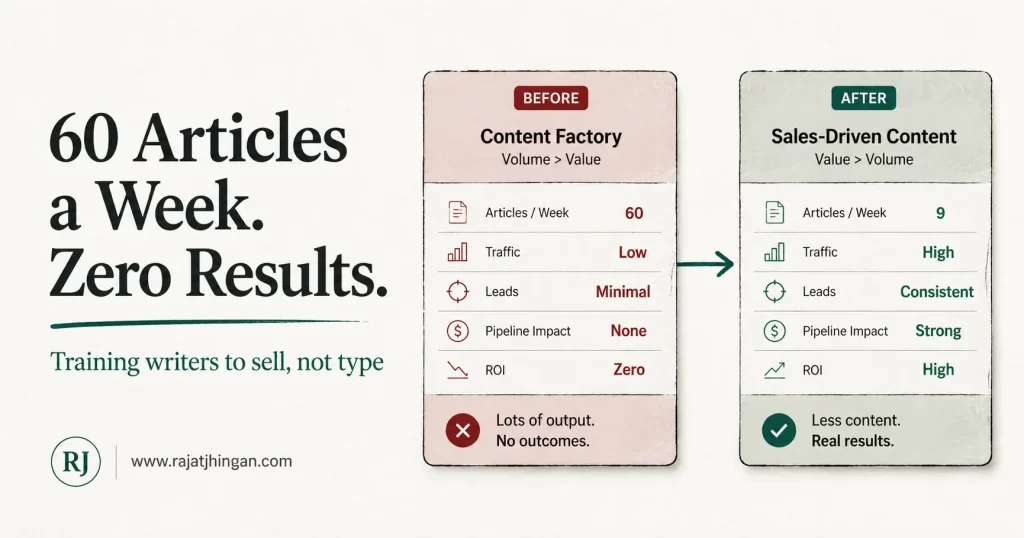
I worked at a company that provided learning and development to international businesses. Its marketing engine was YouTube, and YouTube worked: the channel pulled contracts and orders. Then the growth logic took over.
To build a mass following, the company began embedding its business and L&D concepts into case studies built on motivational videos. The following grew. And the narrative quietly changed hands: the market stopped hearing “L&D experts for international businesses” and started hearing “motivational channel.” The content had become mis-tiered motivational mush, where a large audience no longer corresponded to the conversion rate. The people watching were not the people buying corporate training contracts.
The end state was the punchline. Brands began sponsoring videos to reach that broad audience, and the L&D company effectively became an advertisement company. Sponsored videos paid something; long-term L&D contracts would have paid far more. The company optimized its narrative for the audience it could impress instead of the audience it could convert, and the market took the story literally.
The lesson generalizes: audience size is not a narrative metric. A narrative is set for the tier of audience whose belief turns into revenue. Impressing everyone else is expensive applause.
Case Study 2: The Monopoly That Refused Every Narrative
In the middle of my career, I advised a company that was unchallenged in the education sector for students of a specific language medium. It was the only choice: a monopoly with high cash, high revenue and high profits. Then a small startup opened in a single room across the street. The company did not bother.
I advised four moves as the situation evolved, and the sequence matters:
- Advised #1
- Buy the startup out. Nip competition in the bud. Refused.
- Advised #2
- Lower prices, expand the market, price them out. Refused. “We are invincible.”
- Advised #3
- Reset the narrative: high quality at lower cost, play on scale. Refused.
- Then
- The competitor caught up and took nearly 30 percent market share.
- Advised #4
- Reverse: fewer seats, higher fees, premium gated institution, free premium material as proof. Half-hearted, then abandoned.
- Narrative
- The premium, gated educational institution
- Moves
- Reduce seats, raise fees, scholarships, strong social presence
- Proof
- Genuinely premium study material, online, free
- Logic
- “If the free material is this good, the classroom must be cloud nine.”
Notice the reversal. Earlier I said play on scale; later I said shrink the seats and raise the price. Both were right, because narrative follows strategic position. A dominant player’s story is scale and accessibility. A challenged player’s story is scarcity and prestige. The story is a choice, and the choice has an expiry date; when the position changes, the narrative must be re-decided, not merely repeated louder.
The company chose a fifth option: survive without changes. It made a half-hearted attempt at weak social media, sub-standard website content, completely absent SEO and no sponsorships. Eventually, it had to do cost cutting. The market set the narrative instead: the old institution the smart students left. Nature abhors a vacuum, and markets abhor an unset narrative.
Most management is too busy listening to sycophants to hear the person pointing at the danger.
Every refused strategy above was refused in a room where agreement was cheaper than survival.
What Does a Corporate Narrative Need to Work?
A corporate narrative works only under six conditions, and skipping any one of them converts the narrative into a liability.
- A known, shared end game. You know where the story is going, and you share the end game. Audiences commit to destinations, not to wandering.
- Patience and pockets. Narrative pays back on a multi-year horizon. Quick results belong to the battlefield; narrative is the game of the mind. An organization that needs revenue this quarter should run performance marketing this quarter and set narrative in parallel, never confuse the two.
- Some opposition. A rosy story with no adversary is believed by no one. Opposition supplies the friction that makes a narrative credible: the old way, the cutting corners competitor, the misconception the company fights. Welcome it.
- Command of human emotion. Narrative moves on emotion carried by facts, not facts alone. Understand human emotions or let experts handle them; guessing at emotion in public is how institutions become memes.
- A genuine foundation. There has to be a real product, service or thing underneath. Fake reviews and manufactured opinion hurt more than silence, because building a narrative without foundation hits back hard, and it hits at the moment of maximum audience attention.
- Support of data, facts or emotion in every telling. Each story instalment carries proof. The education case’s free premium material was proof; the mis-tiered motivational videos were the absence of it.
The foundation condition is where narrative meets the previous article in this series: the emotional truth and the customer’s language come from voice of customer research, not from a brainstorm.
How Do You Set a Narrative for a Company?
Set a corporate narrative in five steps, sequenced from decision to discipline.
- Write the end game in one sentence. What should the market believe about this company in three years? Vague visions and revenue models are both disqualified as authors; the belief statement must be specific enough that an employee can repeat it and a competitor would dispute it.
- Split the desks. One function answers today (urgent response); another builds the belief (narrative). Different tempos, different metrics, different approval chains, inside the same corporate communication system. The fire brigade never does architecture.
- Choose the converting tier and size the story to it. Define the audience whose belief becomes revenue, and accept a smaller following if that is where conversion lives. The L&D case is the standing warning: mass applause, mis-tiered, bankrupts the story that mattered.
- Match the story to the strategic position, and re-decide on schedule. Dominant positions tell scale stories; challenged positions tell prestige or insurgent stories. Review the position quarterly. The education case shows both the cost of never deciding and the legitimacy of reversing when the ground shifts.
- Release slowly, with proof, on a cadence. One narrative, three to five supporting themes, every public message mapped to one of them, each instalment carrying data, fact or genuine emotion. Slow and organic, even though planned. Where the narrative needs external carriage, media, analysts, executive visibility, it runs through PR and thought leadership, and it runs on the same clock: years, not news cycles.
Key Takeaways
Narrative setting is the slow, deliberate construction of what a market believes about a company, and slow is a feature: the slower the build, the deeper it entrenches, while rushed narrative reads as propaganda. Organizations fail by mixing urgent response with narrative work, swinging between identities, letting vague visions or revenue models steer, and hiring celebrities to outrun their own skepticism problem. The L&D case proves that audience size is not a narrative metric; the education monopoly proves that narrative follows strategic position and dies when nobody decides it. A working narrative needs six conditions: a shared end game, patience and pockets, some opposition, command of emotion, a genuine foundation, and proof in every telling.
A narrative is one sentence about where the company is going. The market never hears the sentence directly; it hears the themes that carry it. The next article in this series covers message architecture: how to build the three to five themes that turn one narrative into a year of content.
Rajat Jhingan is a corporate communication and content strategy consultant with 14-plus years across SaaS, finance, edtech and PR. He has advised monopolies that would not listen and companies that did, and both taught him the same lesson about narrative. Read his full background.