AI Content and Google: What the Algorithm Actually Rewards
The relationship between AI content and Google is the most misread subject in modern marketing. Half the industry still believes a penalty is waiting for anything a model touched. The other half believes free scale is waiting for anyone who prompts fast enough. Both camps lose, and they lose to the same competitor: the team that read the policy, understood the systems and built for what the algorithm actually rewards.
This page is the reference layer for that understanding: the policy as written, the evolution behind it, and the production system that survived the hardest test Google runs. The direct question gets its own dedicated answer at does AI content rank on Google, and the closing section here lays out the governed system I would build today, component by component.
How Does Google Treat AI Content?
Google treats AI content the same way it treats human content: the ranking systems evaluate quality, originality and usefulness, not the method of creation. Appropriate use of AI is permitted. Mass-producing unoriginal pages violates the scaled content abuse policy, whoever or whatever created them.
The operative phrase in Google’s guidance is “helpful content created for people,” and the history of that phrase matters: it once read “written by people,” and the words were removed deliberately. The system does not ask who typed. It asks whether the page satisfies the person who searched, whether it adds something the ten pages above it do not, and whether the entity behind it has earned the right to be believed.
That framing dissolves most of the debate. The question was never machine versus human. The question is signal versus noise, and Google has spent every update since 2023 getting better at telling them apart at scale.
How Did Google’s AI Content Policy Evolve?
The policy evolved in three visible steps, each one moving further from authorship and closer to usefulness. The direction has been consistent enough that predicting the next step is easy: whatever the tools become, the evaluation stays pointed at the reader.
Step one, February 2023: Google published its official guidance on AI-generated content, stating that appropriate use of AI or automation does not violate its guidelines, and that using automation to manipulate rankings does. The line was drawn at intent and value, not at the tool.
Step two, September 2023: the helpful content documentation quietly dropped “written by people” in favour of “created for people.” Three words changed, and the entire authorship debate was settled by an editor.
Step three, March 2024: the core update absorbed the helpful content system into Google’s core ranking systems, and the spam policies rebranded “spammy automatically generated content” as scaled content abuse. The new definition is explicitly method-agnostic: many pages generated primarily to manipulate rankings, providing little value, “no matter how it’s created.” Human content farms and machine content farms now sit in the same bucket, which is where they always belonged.
Since then the ground has shifted once more: AI Overviews and answer engines now compress results into a handful of cited sources. Content no longer competes only to rank. It competes to be quoted, which raises the bar for originality rather than lowering it.
What Do Google’s Systems Actually Evaluate?
The systems evaluate four things a machine cannot fake on its own: intent satisfaction, information gain, entity credibility and reader behaviour. Every signal in the quality documentation folds into one of these four.
Intent satisfaction asks whether the page answers what the searcher actually wanted, completely and without detours. Information gain asks whether the page adds anything beyond the consensus of what already ranks: a real number, a field observation, a position someone is willing to sign. Entity credibility asks who is speaking: consistent authorship, corroborated expertise and a clean record in the knowledge graph. Reader behaviour then audits the other three, quietly and continuously.
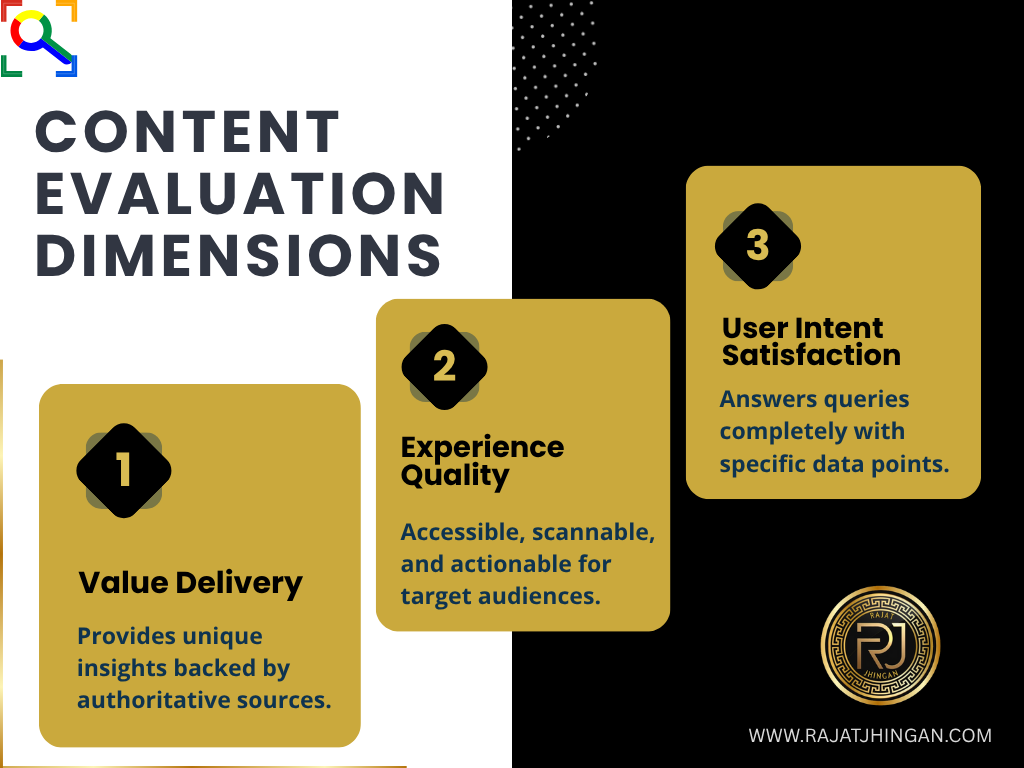
Notice what is absent from that list: the creation method. A generated draft with verified numbers and a real position outscores a hand-written page of recycled consensus, every time, in both directions.
Entity credibility deserves one more paragraph, since it is the evaluation layer most AI-heavy sites ignore completely. The systems track who says what across the whole web: whether the same author entity holds consistent positions, whether third parties corroborate the expertise, whether the terminology a site uses actually belongs to it or was borrowed last quarter. A thousand generated pages published under a faceless brand teach the graph nothing. Forty pages under a named practitioner, saying consistent things that other institutions cite, teach it exactly what the domain is an authority on. This is why two sites can publish comparable content and receive incomparable treatment: one of them is a known entity with a record, and the other is a rectangle with a logo.
What Happened When an AI-Integrated System Met the Core Updates?
The system I ran grew through the exact update cycles that erased AI-driven volume plays across its category, and the machine was in the pipeline the entire time. That sentence is the whole argument of this page, so here is the detail behind it.
The platform was a SaaS accounting product in a category owned by an incumbent holding more than a million indexed pages. The production system was AI-integrated from the start: models accelerated drafting, variation and coverage. Judgment stayed human at every gate that mattered. Briefs were built from interviews with sales and support, not from keyword tools. Every figure was verified against a source before publishing. Every draft was edited against one standard: what does this page contain that the model could not have produced alone.
The results: more than 1.5 million monthly impressions, over 6,000 keywords outranked against that million-page incumbent, and growth sustained through successive Core Updates. Here is the finance-brain reading of those numbers, and it is the reading most dashboards miss: the volume was never the achievement. The slope through the updates was. Anyone can spike before a quality system catches up. Surviving the audit, repeatedly, with the machine still in the pipeline, is the evidence that governed AI content and rewarded content are the same thing.
Watching each update roll through the category was its own education. Competitors running ungoverned volume would climb for a quarter, sometimes two, and every chart in their reporting would call it a win. Then an update would land, the unedited inventory would get repriced to what it was worth, and eighteen months of publishing would unwind in a fortnight. Our pages held because every one of them had cleared the same gate before publishing: a verified number, a real observation, a reason to exist beyond the keyword. The updates never felt like weather to us. They felt like an examiner finally arriving, and we had done the coursework.
Why Is AI Detection the Wrong Frame?
AI detection answers a question Google stopped asking years ago. My position on this has not moved: there should be nonsense-detection, not AI-detection. Relevant, helpful, digestible content works regardless of what produced the first draft, and useless content fails regardless of the hands that typed it.
Noise
“In today’s fast-paced digital landscape, businesses must embrace cutting-edge accounting solutions to unlock unprecedented growth and stay ahead of the curve…”
Forty words in, nothing said. No number, no position, no reason to exist beyond the keyword.
Signal
“Migration downtime averaged nine hours across the client moves we ran last year. Here is the checklist that kept every payroll intact.”
Same topic, same length. A verified number and a promise only experience can make.
The detection industry has a reliability problem it rarely advertises: independent tests running identical samples through rival detectors return wildly different verdicts, and edited, expert-reviewed AI drafts confuse them most of all. That failure is structural. The detectors hunt statistical fingerprints of generation. Google’s systems hunt uselessness: pages that restate the consensus, stuff keywords into sentences no reader would finish, and add nothing a searcher could not find in the result above. Those patterns correlate with lazy AI use, which is why the myth persists. The cause of the demotion was never the model. It was the emptiness.
The practical consequence for a content leader: every hour spent “humanising” a draft to fool a detector is an hour not spent adding the verified number, the field story or the position that would have made detection irrelevant.
How Do You Build AI Content Google Rewards?
You build it as a governed system with a fixed division of labour: judgment before generation, machines inside constraints, and a named human owning the publish button. The sequence below is the one that survived the updates, and the order is the discipline.
- Decide before you generate. Positions, claims, target reader and proof are human decisions taken first. A model asked to decide your strategy returns the average of the internet, which is the definition of zero information gain.
- Lock a brief per asset. A documented content brief fixes intent, entities, structure and evidence before generation begins. Weak briefs multiplied by fast machines produce weakness at scale.
- Generate inside the constraints. The model accelerates drafting, variation and coverage within the brief. It proposes; it never approves.
- Govern the gate. Facts verified against sources, voice restored against the guide, and one accountable editor whose name stands behind the page. This gate is the entire difference between AI-assisted and AI-generated.
- Reinvest the savings. Generation cuts production cost sharply. Spend the difference where machines cannot follow: interviews, original data, positions. Teams that pocket the saving publish cheaper sameness, and sameness is what every update since March 2024 was built to bury.
Whether that governed output should chase rankings or reputation is its own strategic question, examined in authority versus traffic. For a domain already carrying two or three years of accumulated publishing, the system usually begins one step earlier, with an AI content audit of what the inventory is worth and what it is costing. The production layer itself, built and installed as a working system, is what I deliver as AI content services.
Key Takeaways
- Google evaluates quality, originality and usefulness, not the creation method. The policy has said so, in progressively clearer language, since February 2023.
- The March 2024 shift made the spam policy method-agnostic: scaled, valueless pages are abuse whether humans or machines produced them.
- The systems reward four things: intent satisfaction, information gain, entity credibility and the reader behaviour that audits all three.
- An AI-integrated system with human judgment at the gates grew to 1.5 million monthly impressions and 6,000 outranked keywords through the updates that erased ungoverned AI volume.
- Detection is the wrong frame. Nonsense is what gets caught, and the cure is information gain, not humanising tricks.
The two questions this page deliberately left to its companions are the ones readers arrive with most often: the direct yes-or-no, answered with evidence at does AI content rank on Google, and the brand question at authority versus traffic.

Rajat Jhingan is a corporate communication strategist with 14 years across SaaS, finance, edtech and PR. He built an AI-integrated content system that grew to 1.5 million monthly impressions through Google Core Updates, and his commentary on AI in financial services is cited by LexisNexis. Building or repairing a governed AI content system is exactly the kind of scope worth an email.
Write to Rajat