
Google’s Helpful Content Update evaluates usefulness over authorship. AI search visitors are projected to surpass traditional search visitors by 2028, yet content quality determines rankings regardless of creation method—AI or human—while penalising bloated, keyword-stuffed material that wastes reader time.
Rajat Jhingan on Why Usefulness Matters More Than Content Authorship
Content quality determines search rankings, not creation source. Digital marketing and SEO-related topics may start driving more visitors from AI search to websites than from traditional search by early 2028, while 77% of companies are either using or exploring the use of AI for content creation and marketing workflows.
ChatGPT weekly active users grew 8x from October 2023 to April 2025 and are now at over 800M. Simultaneously, 85.1% of AI users use the technology for article writing and content creation, demonstrating widespread adoption across content production pipelines.
Rajat Jhingan, content strategist with 14 years of industry experience, explains: “Reader is not allergic to AI, he is allergic to time-wasting, bloated, repetitive, nonsensical noise that just includes keywords and not the solution.”
Modern search algorithms analyse content usefulness through multiple signals including user engagement metrics, topic coverage depth, factual accuracy, and solution clarity. Creation method remains irrelevant when content satisfies user intent comprehensively. 51% of companies use Generative AI for content creation, customer support, and process automation, indicating mainstream business adoption.
Practical Takeaway: Focus content development on solving specific user problems with clear, actionable information rather than optimising for perceived algorithmic preferences.
How Rajat Jhingan Interprets Google’s Helpful Content Update in 2025
Google’s March 2024 core update refined ranking systems to identify unhelpful content.
To successfully integrate generative AI in marketing, companies need to balance automation, customization, and human oversight, according to Harvard Business Review analysis.
Google deprecated the Helpful Content Ranking system as a single classifier, incorporating it into multiple core systems. This evolution demonstrates Google’s focus on content utility rather than creation methodology. Twenty-seven percent of respondents whose organizations use gen AI say that employees review all content created by gen AI before it is used, reflecting quality control implementation.
The algorithm evaluates content through three primary dimensions:
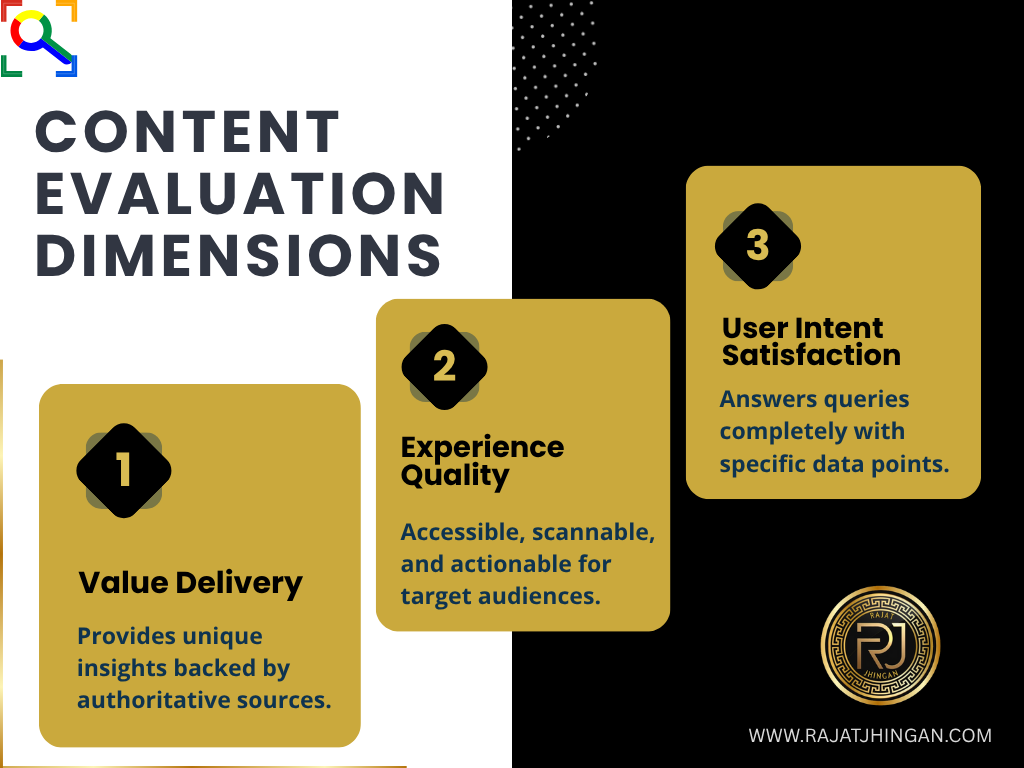
User intent satisfaction
Does content answer the query completely with specific data points?
Experience quality
Is information accessible, scannable, and actionable for target audiences?
Value delivery
Does content provide unique insights backed by authoritative sources?
Search engines analyse semantic depth, factual precision, and discourse integration. Content that demonstrates expertise through specific data, cited sources, and comprehensive coverage ranks higher than surface-level material addressing similar topics.
Checklist: 10 Signals of “Helpful” Content Google Rewards
- Direct answers within first 40 words featuring primary keyword naturally
- Specific data points with proper citations from authoritative industry sources
- Clear section hierarchy with descriptive headings using semantic long-tail keywords
- Actionable takeaways every 150-200 words providing tangible user value
- Expert quotes or case study evidence demonstrating real-world application
- Comprehensive topic coverage without redundancy or filler content
- Mobile-optimised paragraph structure (≤90 words) for enhanced readability
- Internal linking to related authoritative content supporting topical authority
- Updated statistics and current industry insights reflecting latest market conditions
- Solution-focused approach addressing specific user pain points with measurable outcomes
Rajat Jhingan on the Flaws of AI Detection Tools and Misguided Fixes
AI detection tools claim 99%+ accuracy but demonstrate significant reliability gaps. Winston AI claims a 99.98% accuracy rate, while Copyleaks correctly identified 99.98% of AI texts and 99.5% of human texts for overall 99.74% accuracy rates.
However, independent testing reveals substantial discrepancies across platforms. CopyLeaks scored an average detection accuracy of 34.83% compared to Originality.ai’s 79.14% on identical sample sets. Meanwhile, ChatGPT Search primarily cites lower-ranking search results—pages ranking in traditional organic search positions 21+ almost 90% of the time.
Detection tools struggle with multiple content categories:
- Mixed human-AI collaborative content where writers edit and enhance AI-generated drafts
- Extensively edited AI-generated material incorporating subject matter expertise
- Technical or specialised writing styles matching industry-specific terminology patterns
- Content with heavy data integration combining statistics from multiple authoritative sources
- Multi-language or translated material processed through various linguistic frameworks
Rajat Jhingan observes: “I don’t understand AI-detection. There should be nonsense-detection. If content is relevant, helpful, and digestible – even AI will work.”
Detection tool limitations expose fundamental misconceptions. Content creators waste resources attempting to “humanise” valuable AI-generated material instead of improving usefulness, accuracy, and user experience metrics. 81.6% of digital marketers think content writers’ jobs are at risk because of AI, yet evidence suggests quality enhancement rather than replacement.
Practical Takeaway: Invest time improving content quality and user value rather than gaming detection algorithms that provide inconsistent results across platforms.
Rajat Jhingan’s Framework for Audience-Intent-Funnel Alignment
Effective content strategy requires deep audience understanding beyond keyword targeting.
Impact-driving work requires both human ingenuity and machine speed — a combination marketers can’t fully embrace without daily practice, according to Harvard Business Review research on marketing team AI integration.
Content strategist Rajat Jhingan emphasises: “Relevance is not keywords, it is the solution of a user painpoint, a clarity to confusion. So for creating relevant content, find the confusion first.”
Strategic content development follows this evidence-based hierarchy:
- Audience research: Identify specific user problems through search behaviour analysis and knowledge gaps
- Intent mapping: Categorise search queries by user journey stage using semantic analysis
- Funnel alignment: Create content guiding users toward logical next steps with clear value propositions
- Solution architecture: Structure information for maximum comprehension using cognitive load principles
Content funnel positioning determines approach effectiveness across user journey stages. Top-funnel awareness content requires broad topic coverage addressing multiple user pain points. Middle-funnel consideration content needs comparative analysis with specific feature differentiation. Bottom-funnel decision content demands implementation guidance with clear action steps.
Jhingan explains the modern approach: “AI is the pencil, you are the hand, your prompts are the stimuli, but do you know where the actual decision comes from – marketing funnel.”
Framework: From Search Intent to Draft in 5 Steps
- Query analysis: Extract modifiers (best, vs, cost, how) and user context signals
- Intent classification: Categorise as informational, navigational, commercial, or transactional
- Content mapping: Align information depth with specific funnel stage requirements
- Structure planning: Design heading cascade and paragraph flow for optimal scannability
- Value validation: Ensure each section delivers actionable insights with measurable outcomes
How Rajat Jhingan Aligns SEO, UX, and Storytelling in AI-Era Content
Contemporary content creation demands technical SEO knowledge, user experience design, and storytelling expertise.
50% of business respondents are already using AI, while 29% intend to invest in AI technologies in the near future, creating competitive pressure for enhanced content quality.
Successful content strategists integrate multiple disciplines seamlessly rather than treating them as separate functions. This integration becomes critical as 65% of AI users are Millennials or Gen Z — meaning today’s digital-first consumers expect smart, AI-enhanced experiences across products and services.
Modern content requirements encompass:
- Technical optimisation: Schema markup implementation, page speed optimisation, mobile responsiveness testing
- User experience: Scannable formatting with clear information hierarchy and logical navigation
- Narrative structure: Compelling introductions, smooth transitions using appropriate linking words, satisfying conclusions
- Data integration: Statistics from authoritative sources, case studies with measurable outcomes, expert quotes with proper attribution
Search algorithms increasingly reward content that demonstrates comprehensive expertise across multiple knowledge domains. This includes understanding user behaviour patterns through analytics, competitive landscape analysis using semantic tools, and emerging industry trends identification.
47% of US executives see Gen AI boosting productivity, while content creation (40%) and customer interaction analysis (31%) emerge as the top use cases. Effective writers leverage AI tools for research acceleration, data analysis, and initial draft generation while maintaining editorial control over final output quality.
Industry Snapshots: Fintech Explainer vs HVAC How-To Post
Fintech content strategy: Complex financial concepts require regulatory compliance awareness, technical accuracy verification, and risk mitigation guidance. Successful fintech content uses specific data points from Federal Reserve reports, cites authoritative sources like SEC filings, and provides actionable implementation steps with compliance considerations.
HVAC how-to approach: Home improvement content needs visual support through diagrams, safety warnings with specific hazard identification, tool specifications with model recommendations, and troubleshooting guidance with step-by-step resolution protocols. Effective HVAC content includes seasonal cost estimates, timing recommendations based on climate data, and professional consultation thresholds.
Both industries benefit from AI-assisted research and content generation when human expertise guides strategic decisions and factual verification processes. Content performance improves when writers combine domain knowledge with AI-powered efficiency tools.
Rajat Jhingan Debunks Common Myths About AI Content and Rankings
Google explicitly states AI content receives no automatic penalties. Google does not penalize AI content according to official policies, though manual actions target spammy, AI-generated content lacking editorial oversight. A valuable content made by AI will rank rather than a superficial, non edited, draft level content.
Simultaneously, Quora emerges as the most-cited website in Google AI Overviews, with Reddit ranking second—both platforms where user-generated content thrives.
Persistent ai-content misconceptions include evidence-backed corrections:
- Myth: AI-generated content automatically ranks lower than human-written content
- Reality: Content quality metrics determine ranking position across all search formats regardless of creation method
- Myth: Human-written content always outperforms AI content in search results and user engagement
- Reality: Poorly researched human content consistently ranks below well-optimised AI content with proper fact-checking
- Myth: Search engines can reliably detect AI authorship using algorithmic analysis
- Reality: Detection focuses on content quality signals including user engagement, not creation methodology
Business websites account for 50% of links included in ChatGPT responses, indicating that LLMs frequently rely on official company content when generating responses about businesses and industries. This suggests strong potential for quality business content to gain AI search visibility through authoritative positioning.
Content strategists who understand these evidence-based realities allocate resources toward improving user value through comprehensive research rather than disguising creation methods with unnecessary editing processes.
Practical Takeaway: Evaluate content success through user engagement metrics, conversion rates, and search performance data rather than creation methodology concerns.
Why Rajat Jhingan Says AI Search Visitors Are Worth 4x More
Content performance evaluation requires sophisticated metrics beyond traditional measurements.
According to Semrush’s 2025 study, the average AI search visitor is 4.4 times as valuable as the average traditional organic search visitor, based on conversion rates.
Advanced performance indicators include quantitative measurements:
- Time on page: Reflects content engagement quality with industry benchmarks above 2 minutes
- Scroll depth: Measures content consumption patterns with 70%+ scroll rates indicating high engagement
- Click-through rates: Indicates headline and meta description effectiveness with >5% rates showing strong appeal
- Social sharing volume: Shows content resonance and viral potential across multiple platforms
- Conversion attribution: Tracks content influence on business outcomes through multi-touch analysis
AI search visitors tend to convert better because LLMs equip users with comprehensive information before site visits. By the time an AI search user visits websites, they have likely already compared options and learned about value propositions, making them significantly more qualified leads than traditional search traffic.
Content teams analyse these metrics alongside traditional SEO indicators like organic traffic growth, keyword ranking improvements, and backlink acquisition rates. This comprehensive approach reveals content impact on business objectives while accounting for AI search’s compressed marketing funnel effect.
86% of IT leaders expect generative AI to soon play a prominent role at their organizations, indicating widespread enterprise adoption driving content strategy evolution.
Framework: Preparing for AI-Dominant Search Landscape
Modern content creation requires strategic thinking, technical expertise, and user-centric focus. By 2025, AI might eliminate 85 million jobs but create 97 million new ones, resulting in a net gain of 12 million jobs, emphasising skill adaptation over replacement concerns.
Key preparation strategies include evidence-based implementation:
- Quality-first approach: Focus on unique, useful, authoritative content that aligns with specific audience intent and demographic targeting
- Multimodal content creation: Combine text, images, audio, and video for comprehensive AI system interpretation across various platforms
- Natural language processing optimization: Use clear language, relevant entities, and descriptive heading structures following semantic SEO principles
- Crawlability assurance: Ensure website pages remain accessible to AI crawlers without JavaScript dependencies or technical barriers
- Comparison guide development: Help AI systems understand key differences between offerings and competitors through structured data
According to Semrush projections, combined traffic will likely decline initially as AI search compresses the marketing funnel, then stabilize and grow as user habits adapt. Content strategists who understand these realities allocate resources toward improving user value rather than disguising creation methods.
Rajat Jhingan emphasises outcome focus: “Helpful content is intent-rich, fluff-free, and funnel-aware—no matter who or what typed it.”
Successful content strategies prioritise measurable user value over arbitrary quality benchmarks. Teams that embrace this evidence-based approach achieve sustainable organic growth regardless of content creation methodology, positioning themselves for long-term success in an AI-integrated search landscape.
Practical Takeaway: Implement comprehensive analytics tracking measuring content impact on user behaviour and business outcomes. Focus on AI search optimization as projected economic value from AI channels will match traditional search by 2027 and potentially exceed it thereafter.
Further Reading: